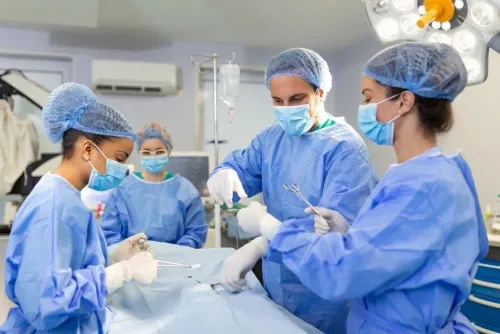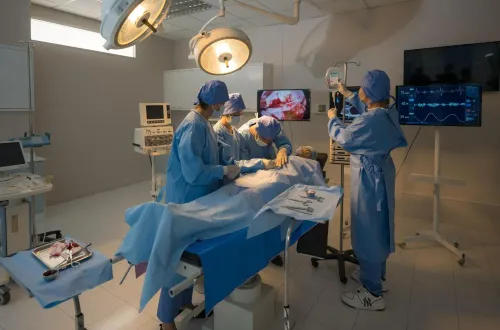

Choosing between robotic and laparoscopic colorectal surgery depends on the disease, the part of the bowel involved, the urgency, and the surgeon’s ability to complete the operation safely. By the end, you will know what each approach changes, when a different operation is more appropriate, and which questions to ask before choosing a hospital or surgical team.
Key takeaways
- Urgent bowel surgery prioritises safety and speed over the access system.
- Tumour location in the colon or rectum can influence the recommended technique.
- Ask how conversion, recovery time and the complete treatment cost are handled.
- Compare the surgeon’s experience with your specific colorectal operation, not just the technology.
How robotic and laparoscopic colorectal surgery actually differ
The operation may be identical; the access system changes. Both techniques use small abdominal ports, a camera and long instruments instead of a large open incision. The bowel specimen may still require one incision to be enlarged for removal.
| Feature | Laparoscopic surgery | Robotic surgery |
|---|---|---|
| Surgeon control | Directly moves relatively rigid instruments | Moves wristed instruments from a console; the robot does not operate independently |
| Vision | Two-dimensional or high-definition monitor | Magnified three-dimensional view |
| Setup | Ports are placed, then instruments enter directly | Ports are placed, then the robot is docked to them |
| Instrument changes | The surgeon or assistant exchanges instruments through ports | The bedside assistant exchanges robotic instruments after docking |
| Assistant access | An assistant helps with suction, retraction and stapling | The assistant uses an access port for suction, retraction, stapling and specimen handling |
| Practical advantage | Familiar, widely available and often faster to set up | Articulation can make deep pelvic dissection and suturing easier |
Robotic surgery does not guarantee smaller wounds, fewer complications or better cancer survival. Laparoscopy does not mean inferior cancer treatment when the surgeon achieves appropriate margins, lymph-node removal and a safe join.
For robotic colorectal surgery in Pune or laparoscopic colorectal surgery in Pune, results depend more on the operation, surgeon’s technique and hospital support than on the platform label.
Which colorectal problems need surgery, and does urgency change the choice?
An operation is considered for colon or rectal cancer, complicated diverticular disease, fistula, stricture, selected inflammatory bowel disease complications, rectal prolapse and complex recurrent disease. Diagnosis comes first: colonoscopy, biopsy, CT or pelvic MRI may define the problem, while blood tests, nutrition, heart and lung assessment determine whether you can tolerate surgery.
- Plan an operation for cancer when resection offers disease control, including colon resection or rectal surgery.
- Consider surgery for diverticular fistula, narrowing, persistent inflammation, obstruction or perforation. Do not count uncomplicated attacks and operate automatically after a fixed number; symptoms, complications, previous operations and operative risk matter.
- Consider surgery for a prolapse, severe Crohn’s-related narrowing or abscess, ulcerative-colitis complications, or recurrence made difficult by adhesions and altered anatomy.
| Situation | Possible colorectal surgery options Pune | What changes the choice |
|---|---|---|
| Elective disease | Non-operative treatment, laparoscopy, robotics or planned open surgery | Fitness, anatomy, prior operations, tumour position and surgeon experience |
| Emergency disease | Rapid open surgery, laparoscopy in selected cases, diversion or staged resection | Perforation, faecal peritonitis, severe obstruction, bowel ischaemia or unstable physiology |
An emergency can require removing bowel without immediate reconnection, or creating a stoma. A stoma may be temporary or permanent, and minimally invasive access does not remove that possibility. Ask how the diagnosis will be confirmed, whether diversion or staged surgery is safer, and what happens if a minimally invasive operation must become open.
The right choice is a clinical decision, not a technology ranking.
Why the colon, rectum and tumour position change the decision
Many planned colon resections can be completed laparoscopically when the surgeon can achieve safe cancer margins, remove the correct lymph-node-bearing segment and create a secure bowel join. The decision changes for rectal surgery, especially total mesorectal excision for a low rectal tumour deep in the pelvis.
Robotic assistance may offer practical advantages when rigid laparoscopic instruments make deep dissection or suturing difficult. The challenge increases with:
- A narrow male pelvis, obesity or difficult anatomy.
- A tumour close to the anus or a bulky tumour.
- Previous pelvic treatment, surgery or scarring.
- A reconstruction requiring precise suturing in a confined space.
Wristed robotic instruments and three-dimensional vision can improve access and control in these situations. However, evidence does not establish universal robotic superiority for survival or complications. Experience with the exact operation, particularly low anterior resection or total mesorectal excision, matters more than the platform label.
For low rectal cancer, pelvic MRI shows the tumour’s distance from the sphincter and its relationship to the mesorectal fascia. A multidisciplinary team may recommend chemotherapy, radiotherapy or total neoadjuvant therapy before surgery, which can change the operation. Search results for robotic surgery or laparoscopy for colorectal problems Pune should not replace this staging discussion.
A temporary ileostomy may protect a very low join and reduce the consequences of a leak. A permanent colostomy may be necessary when the tumour involves the sphincter, bowel function would be poor, the tumour position prevents preservation, or the join would be unsafe.
These considerations apply whether you compare laparoscopic colorectal surgery in Pune with robotic colorectal surgery Pune.
What recovery, conversion and total cost should you expect?
Minimally invasive surgery usually means smaller access wounds, less postoperative pain, earlier walking and eating, shorter hospitalisation, and a faster return to normal activity than open surgery when recovery is uncomplicated. The course still depends on the operation, age, fitness, nutrition, anaesthesia, complications and any conversion to open surgery.
| Option | Usual recovery advantages | Important limits |
|---|---|---|
| Laparoscopy | Smaller wounds and earlier recovery than open surgery | Rigid instruments may make deep pelvic work difficult |
| Robotic surgery | Similar small-wound recovery, with improved control in confined spaces | Setup takes longer and the bill is usually higher |
| Open surgery | Direct access for extensive or urgent disease | Larger incision, more pain and slower recovery |
Follow wound-care instructions, keep dressings dry as advised, and report spreading redness, pus, fever or wound separation. Bowel function can change temporarily through gas, loose stools, constipation or urgency. An anastomotic leak, infection, blood clot or persistent vomiting can require antibiotics, drainage, reoperation or readmission.
Conversion is a safety decision, not automatically a failure. Dense adhesions, bleeding, bulky or locally advanced cancer, unclear anatomy, unsafe progress or physiological problems can require an open incision.
Robotic colorectal surgery in Pune usually costs more because of platform and disposable-instrument charges than laparoscopic colorectal surgery in Pune. Request a written estimate covering surgeon and hospital fees, staplers, pathology, intensive care, imaging, oncology care, stoma supplies, and the financial effect of conversion or complications.
Enhanced Recovery After Surgery may include avoiding unnecessary fasting, opioid-sparing pain relief, nausea prevention, early mobilisation and early oral intake.
What to ask a colorectal surgeon in Pimple Saudagar before deciding
Choose based on the operation, anatomy and rescue capacity—not on the newer-looking machine. This is the practical test for robotic surgery or laparoscopy for colorectal problems Pune.
| Approach | Ask | What it should clarify |
|---|---|---|
| Laparoscopy | Can you complete this operation safely laparoscopically? | Experience with the specific resection and pelvic anatomy |
| Robotic surgery | What problem will robotic control solve here? | Whether deep pelvic dissection or suturing justifies the platform |
| Either approach | What is the open-surgery and stoma plan? | What happens if minimally invasive surgery becomes unsafe |
Take this checklist to a colorectal surgeon in Pimple Saudagar:
- What exact operation do I need? Is the disease in the colon or rectum? What do my CT scan, pelvic MRI and colonoscopy show?
- How many procedures of this exact type do you perform, especially low anterior resection and total mesorectal excision?
- What are your conversion-to-open, anastomotic-leak, unplanned-reoperation, readmission and permanent-stoma rates?
- If you cannot complete the operation minimally invasively, will you convert to open surgery, create a temporary ileostomy or make a permanent stoma?
- Where will surgery occur? Does the hospital have colorectal anaesthesia, intensive care, interventional radiology, blood-bank support, cancer-staging pathology and a team that can treat an anastomotic leak?
Dr Kulkarni- Advanced LAPAROSCOPY, Colorectal & ROBOTIC Surgery Clinic can be relevant when the consultation focuses on your diagnosis-specific operation rather than a request for the newest platform. Compare colorectal surgery options Pune by surgeon experience, cancer principles and hospital support; distance matters less when postoperative rescue capability is at stake.
Related services
Advanced LAPAROSCOPY, Colorectal & ROBOTIC Surgery Advanced LAPAROSCOPY, Colorectal & ROBOTIC Surgery Advanced Laparoscopic, Colorectal & Robotic Surgery Services by Dr. Suprashant Kulkarni Dr. View service → |
Laparoscopic Surgery By Dr. Suprashant Kulkarni Laparoscopic Surgery By Dr. Suprashant Kulkarni Dr. Suprashant Kulkarni holds an MBBS and MS in General Surgery from B. J. Medical College, Pune. View service → |
Frequently asked questions
How do robotic and laparoscopic colorectal surgery differ?
Both use small abdominal ports, a camera and long instruments. Robotic surgery adds wristed instruments and a console, while laparoscopy uses instruments controlled directly by the surgeon. The bowel specimen may require an enlarged incision with either technique.
Does an emergency change the choice between robotic and laparoscopic surgery?
Yes. In an emergency such as obstruction, perforation or severe bleeding, stabilising you and completing safe surgery take priority. The surgeon may choose the access method that fits the urgency, findings and available expertise.
Why do the colon, rectum and tumour position affect the decision?
The tumour’s height, distance from the anal sphincter, size and relationship to nearby organs affect the operation’s technical demands. Rectal surgery in a narrow pelvis can require different instrument control from surgery on the right or left colon.
What should I ask about recovery, conversion and total cost?
Ask about the expected hospital stay, return to normal activity, wound care, temporary stoma risk, reasons for converting to open surgery and the surgeon’s conversion policy. Request a written estimate covering surgeon, hospital, anaesthesia, pathology, medicines, follow-up and possible additional procedures.